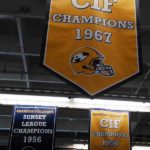
Anaheim Celebrates 50th Anniversary of 1967 CIF Championship
October 3, 2017 by
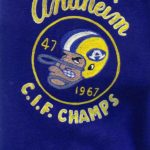
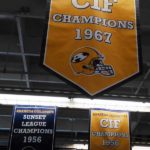
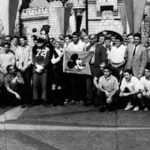
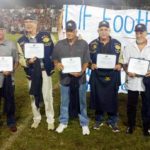 Football players, past and present, along with fans, friends and family, gathered on Friday, Oct. 6th, to celebrate the 50th anniverary of Anaheim High’s 1967 CIF Championship and the 99th year of Anaheim High football.
After a tribute dinner in the Anaheim High Cafeteria, those gathered continued on to Glover Stadium for the varsity game against Katella. Team members from the 1967 Championship Team were presented with commemorative caps and tshirts and applauded during a half-time ceremony.
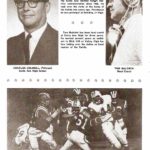
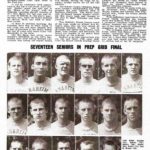
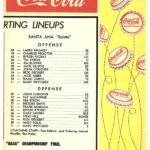
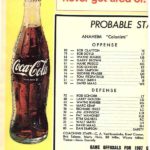
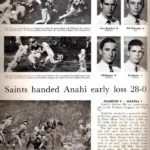
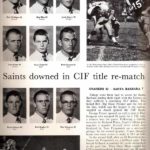
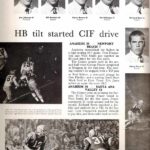
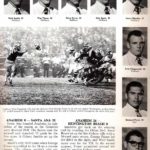
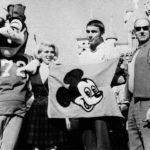
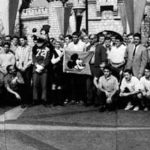
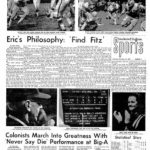
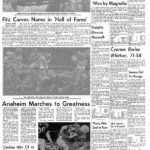
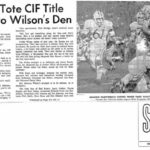
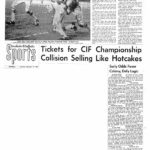
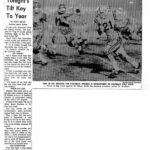
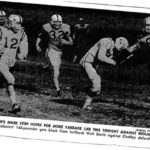
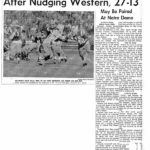
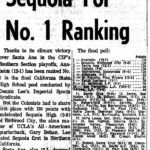
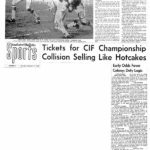
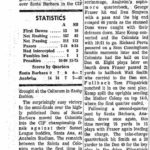
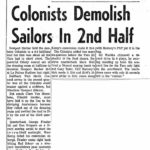
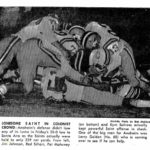
Click here to see photos of the event and continue scrolling to read an article about the 1967 season, along with photos and newspaper articles that recorded this championship year.
♦ ♦ ♦ ♦ ♦ ♦ ♦
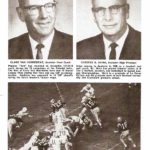
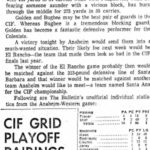
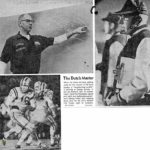
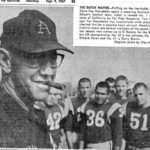
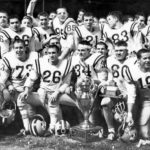 Throughout its nearly 100 years of proud football history, Anaheim has won many games with many great players and many great coaches. But perhaps no Colonists team had a greater journey than the 1967 squad, which won an unprecedented CIF championship.
 The 12-1 campaign, capped off by a memorable triumph over Santa Ana at Anaheim Stadium, forever certified the Colonists under legendary head coach Clare Van Hoorebeke as the finest program of its era in the midst of its finest hour.
 The beloved “Van,” already Orange County’s all-time winningest head football coach by that time, was in his 18th season at Anaheim, winning or sharing 13 Sunset League crowns. The 1956 team with Mickey Flynn had earned a co-championship, but the Colonists had come up just short twice more in 1962 finals against Loyola, and in a crushing 35-14 loss against El Rancho in the 1966 championship game.
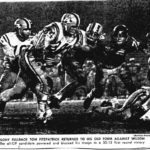
Though ready to hit the field with an amazing array of talented players, the Colonists entered the 1967 season with much uncertainty. Rising star quarterback Chappy Looney, who had been expected to assume a starring role in the Anaheim offense, died unexpectedly the previous spring. Additionally, many doubted that ferocious senior fullback/linebacker Tom Fitzpatrick could recover from a torn ACL injury suffered during the 1966 playoffs.
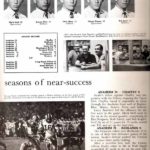 But Van and his esteemed coaching staff, led by veteran assistant Brant Cowser and highly motivated young coordinators Bill Miller on offense and Bob Salerno on defense. Wayne Atkins, John Balaam, and Marty Hicks rounded out the staff that had Anaheim ready to compete, and the Colonists opened up with shutout wins over Chaffey and Redlands in non-league play.
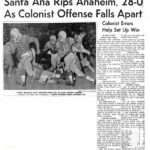
 However, Anaheim looked sluggish in a 9-7 win over Marina in its Sunset League opener. Then, the bottom fell out as the Colonists were humiliated in a 28-0 wipeout at the hands of Santa Ana, the worst loss of Van Hoorebeke’s coaching career.
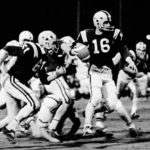
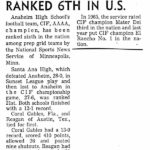
Seeking a spark on offense, Van Hoorebeke and Miller elevated sophomore George Fraser to the starting quarterback position, while Tom Fitzpatrick was cleared to play full time once again. The results were immediate, as Anaheim dominated its next five opponents by a combined score of 130 to 33. Though Santa Ana claimed the Sunset League title, Anaheim’s 8-1 record was good enough for an at-large berth in the 4-A playoffs.
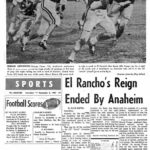
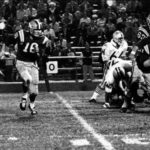 In the first round, Fraser ran for two touchdowns, while cornerback Dave Maas had a team-record four interceptions and end Kym Salness added two more picks to lift Anaheim past Long Beach Wilson 35-13. Rematching in the quarterfinal round against El Rancho, the Colonists dethroned the defending CIF 4-A Division champions in a solid 28-14 win. Halfback Walt Smith ran 20 times for 137 yards as Anaheim totaled nearly 400 yards in total offense against El Rancho’s formidable defense. Fitzpatrick, Fraser, and Maas all scored TDs to push Anaheim into the semifinals.
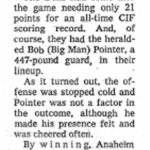
 At the Los Angeles Memorial Coliseum, Anaheim faced off against undefeated Santa Barbara. The Channel League champion Dons appeared invincible, having scored nearly 500 points on offense with explosive quarterback Grady Hurst and punishing tailback Sam “Bam” Cunningham, while Santa Barbara’s defense boasted the “Four Teen Tons” led by Bob “Big Man” Pointer, who was arguably the biggest prep football player in history, tipping the scales at 447 points.
The Colonists showed no fear, as Fraser threw for over 200 yards and three touchdowns. Fitzpatrick caught one TD pass and ran for two more scores as Anaheim carved up the enormous but slow-footed Dons defense for a 42-7 win.
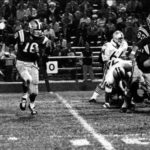
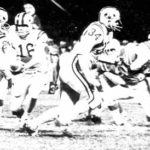
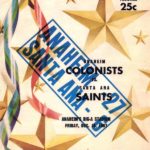
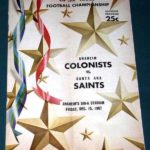
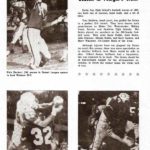
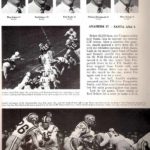
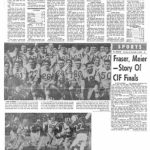
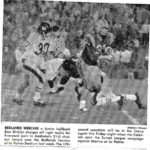
The Semifinal victory set up a rematch with Santa Ana at the Big A, where 26,383 fans filled the stadium for the 4-A title showdown. Following a scoreless first quarter, Anaheim’s running game went to work as halfback Eric Janes, Smith, and Fraser ran behind the blocking of Fitzpatrick, who then finished two scoring drives with touchdown runs in the second quarter and a 14-0 lead. Janes, who was the star of the game with 136 yards on 15 carries, added his own touchdown on a 33-yard scoring run in the third quarter. The Saints and vaunted flanker Isaac Curtis were held to a single score, while Fraser put the finishing touch with a touchdown pass to Rod Schorr in the final minutes of the 27-6 victory.
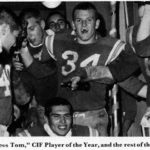 Fitzpatrick was named the CIF 4-A Division Player of the Year, while Fraser became the first and only sophomore player ever named to the All-CIF 4-A Division team, while linemen Wayne Bugbee and Larry Golden also earned All-CIF honors.
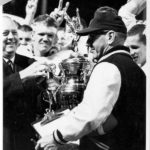
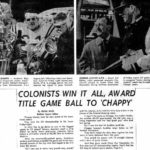
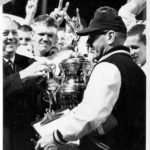
Following the game, the jubilant Colonists gathered on the field and celebrated as CIF commissioner Bill Russell handed the championship trophy over to coach Van Hoorebeke, who took pride in his typical, understated way. “We didn’t necessarily have the greatest talent in the world this year, but there was no one with more desire. Yes, sir, they’re champions.”
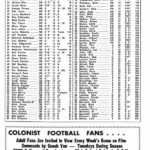
ANAHEIM COLONISTS FOOTBALL – 1967
Head Coach – Clare Van Hoorebeke
Offensive Coordinator – Bill Miller
Defensive Coordinator – Bob Salerno
Assistant Staff – Wayne Atkins, John Balaam, Brant Cowser, Marty Hicks
Head Coach – Clare Van Hoorebeke
Offensive Coordinator – Bill Miller
Defensive Coordinator – Bob Salerno
Assistant Staff – Wayne Atkins, John Balaam, Brant Cowser, Marty Hicks
Won 12, Lost 1
(6-1) 2nd Place Sunset League
CIF 4-A Division Champions
24 Chaffey 0 W
21 Redlands 0 W
9 Marina* 7 W
0 Santa Ana* 28 L
24 Huntington Beach* 0 W
39 Newport Harbor* 7 W
34 Santa Ana Valley* 13 W
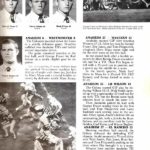
6 Westminster* 0 W
27 Western* 13 W
35 LONG BEACH WILSON 13 W
28 EL RANCHO 14 W
42 SANTA BARBARA 7 W
27 SANTA ANA 6 W
CIF 4-A Division Champions
24 Chaffey 0 W
21 Redlands 0 W
9 Marina* 7 W
0 Santa Ana* 28 L
24 Huntington Beach* 0 W
39 Newport Harbor* 7 W
34 Santa Ana Valley* 13 W
6 Westminster* 0 W
27 Western* 13 W
35 LONG BEACH WILSON 13 W
28 EL RANCHO 14 W
42 SANTA BARBARA 7 W
27 SANTA ANA 6 W
ALL-CIF 4-A DIVISION
Tom Fitzpatrick, Back – Player of the Year
George Fraser, Back
Wayne Bugbee, Guard
Larry Golden, Guard
George Fraser, Back
Wayne Bugbee, Guard
Larry Golden, Guard
ALL-SUNSET LEAGUE
Wayne Bugbee OG – 1
Tom Fitzpatrick RB – 1
George Fraser QB – HM
Larry Golden DG – 1
Jim Johnson LB – 1
Marc Kemp DT – HM
Dave Maas DB – 1
Pat Mahoney C – HM
Richard Perez DE – 1
Rod Schorr DT – 1
Walt Smith RB – 2
Tom Fitzpatrick RB – 1
George Fraser QB – HM
Larry Golden DG – 1
Jim Johnson LB – 1
Marc Kemp DT – HM
Dave Maas DB – 1
Pat Mahoney C – HM
Richard Perez DE – 1
Rod Schorr DT – 1
Walt Smith RB – 2
Anaheim Loses Custom Car Guru Stan Betz
September 28, 2017 by
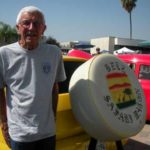 Legendary hot rodder and custom car builder, Stan Betz from Class of ’46, passed away today (Sept. 28). An AHS Hall of Famer, Stan had recently celebrated his 90th birthday.
Betz, who lost his right leg below the knee to polio at age 3, grew up on a 10-acre orange ranch on Lemon Street in Anaheim.
But Betz wasn’t interested in ranching or learning his father’s skill as a hybridizer of orange trees and other fruit bearing plants.
What really caught his attention, and kept his interest for the rest of his life, was cars. And he had a great role model to encourage him.
His uncle Dick Kraft, one of the original hot rodders, was known for his many innovations, which included building and driving the first rail job called “The Bug.” A clone of “The Bug” is on display in the National Hot Rod Association Museum in Pomona. Kraft’s other custom-built cars are highly collectible.
Like his uncle, Stan’s cars have become famous in the automotive world and are shining examples of his legendary skills as a master car builder and painter.
His journey to becoming the center of the 1950s rod and custom culture, as well as a businessman who figured out a way to make money at doing something he loved, included a stop at Anaheim High School.
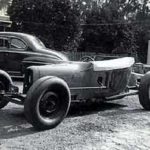 A 1946 grad, Betz confesses to having spent most of days at Anaheim High in the machine shop working on hot rods. He owned a Model-A roadster with a V-8 engine that was shoe-horned in during welding shop. Three years later he built a track T that he raced on local outlaw tracks when he wasn’t working the night shift at a gas station.
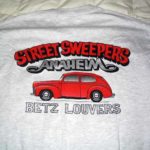 Back in the ‘50s, when hot rodding and car clubs were in high gear, Stan’s shop (a single car garage he rented for five bucks a month located in the alley behind the police station) was the meeting spot for The Street Sweepers, a car club he founded, named and sponsored.
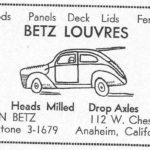 Along with holding their meetings, the Sweepers would punch louvers, which are vents located in strategic positions on a car’s body to allow hot air to escape. Betz and his team were stamping louvers in hot rods, racecar hoods, deck lids, fenders, or anything a custom-car owner wanted punched. Guys came from miles around to get ventilated.
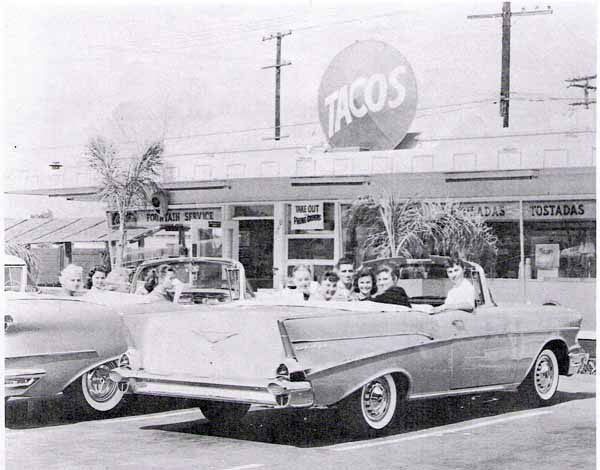
AHS Yearbook Ad of the Bean Hut
When not at Betz’s shop, the Sweepers would hang out at the 76 Station at the corner of Palm (Harbor) and Center (Lincoln) or at the Bean Hut, a.k.a the La Palma Drive-In. The Sweepers gave this iconic hangout the nickname “Bean Hut” and the drive-in became the favorite of car clubs throughout Orange County and beyond.
Back in the 1950s Stan drove a 1932 Sedan with a “hot flat head” that he finished in bright yellow. He also owned a ’51 Ford pick-up with Von Dutch flames, a cut down hood and “big and little” tires.
His love affair with the automobile continued throughout the decades when members of the Street Sweepers traded in their custom rides for college degrees and lives in the slow lane. Stan stayed in the trade and created automotive masterpieces.
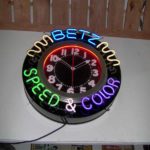
When the louver business slowed down, Betz added paint products to his enterprise, which became Betz Speed and Color. His shop became known as the best place to find the exact color, especially for customers who wanted to match an existing stock or custom paint color.
Featured in countless magazine and newspaper articles, Betz has also been included in “Hot Rod History – Book Two: The Glory Years” by Tom Medley. Chapter Two is dedicated to Betz, “one of the best paint mixers around. Betz works in the sun and can match paint to an exactness that defies even the computers.”
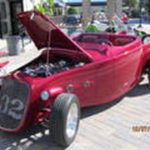 One of his award-winning vehicles was a roadster he named “2032,” a completely custom-crafted candy raspberry red highboy pickup with Lincoln Mark VIII running gear.
Along with cars, Stan had a unique collection of MGM movie miniature cars, boats, trains and other vehicles that Hollywood filmed being driven over cliffs, crushed, crashed and blown up in thousands of movies. The 100-piece collection was featured in an early episode of “Visiting with Huell Howser.”
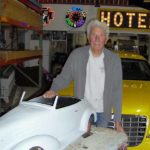
Reggie Massey – Nov. 6, 1926 – Aug. 22, 2017
September 18, 2017 by
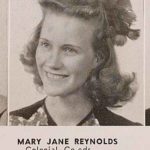 Anaheim High has lost Class of 1944 graduate Reggie (Reynolds) Massey. Her birth name was Mary Jane but this spunky lady chose to be known as Reggie. She was nearing her 91st birthday when she passed away peacefully with her family at her side.
Reggie helped launch the Anaheim High School Alumni Association (AHSAA), when she was directed in 2008 by her classmates to explore what they could do to help “Old AU.”
Cook Auditorium was identified as an area of the school that needed renovation. While a major remodel hasn’t occurred as yet, the District painted, installed new flooring and made other improvements to the historic 1,200-seat auditorium built in 1936 as a Works Progress Administration project. Architectural plans were also drawn up for a complete renovation that would improve the stage site line, upgrade equipment and restore the school’s historic Robert Morgan pipe organ.
But more importantly, this effort brought alumni back to the school and helped provide a voice for some 3000 students.
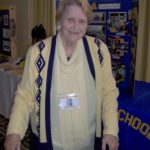
Another of Reggie’s efforts focused on the importance of obtaining the block of buildings on Lincoln Avenue next to Cook Auditorium. In 2016, the School District purchased this large parcel of land that will be used to expand the AHS campus.
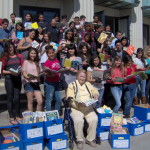
Along with planning her class reunions for many years, Reggie was a champion of the high school by donating funds and materials, including hundreds of books used for the “Read Across America” program.
Reggie was a transplant to Southern California by way of El Dorado, Texas. More about Reggie’s life may be learned from a story about her in the Orange County Register written in 2008 by Eric Carpenter (also an AHS graduate):
“Her adult life had taken her away from Anaheim.
After high school, Reggie attended Fullerton Junior College for a few months before marrying her high-school sweetheart, Robert Massey, a career Navy man who flew fighter planes in the Pacific during World War II.
After the war, the couple moved around the country before settling on the East Coast.
That’s where Reggie first got the bug to become a leader for change. When she enrolled her son in school, she noticed there was no sidewalk leading to the school. And the lumber yard next door burned wood during the day, creating a potentially dangerous cloud that drifted toward the school.
“So I went to the mayor…And before long, they built a sidewalk and stopped burning wood,” she says. “That’s where I learned: When you see something you want changed, you have to ask.”
Reggie had five children – four boys and a girl. And the family settled in Arlington, VA where she lived for 43 years. She worked full-time as an administrative assistant for a U.S. Congressman, where she learned plenty about finding the people with the power to make change.
And she gained skills as an organizer and fundraiser there too, helping start an alternative school for students unmotivated by sitting at a desk all day.
Reggie returned to Orange County every few years to visit family, but she had no plans to move back – until Valentine’s Day 2002, when her husband died after an extended battle with Alzheimer’s disease.”
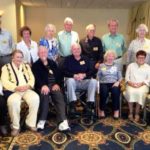
Reggie (far left in front row) with her classmates at their last reunion.
Once Reggie returned to Orange County, she immediately began contacting her Colonist classmates and helped organize several reunions.
“Reggie was a visionary! She had creative ideas that made it possible for her many friends to have a really good time together, “said classmate Gania Demaree Trotter. “Reggie’s suggestions were always different and unique! ”
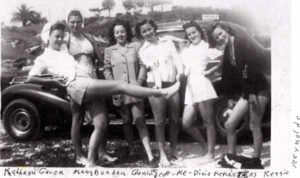
Gania related this story about Reggie: “After the excitement of graduation she topped it all off by proposing she drive six of us to Laguna Beach for an overnight by the ocean. We spent the entire weekend laughing, swimming, and getting really sunburned! The memory of her inspired leadership and great friendship will remain with us always.”
AHS ’62 Grad Brings “Man Trouble” to Stage
September 8, 2017 by
 Arthur and playwright David Macaray (’62) has brought “Man Trouble” to Fullerton’s Stages Theater in the form of two one-act comedies “Food Court” and “Discount Murder.”
His two newest playlets, playing through Sept. 16, feature his signature quirky characters “whose oddities bounce off one another like pinballs, yet whose issues and problems reflect the concerns of everyday Americans,” according to a review in the OC Register.
A ninth-generation Californian and son of Larry Macaray (’36), David has written for the LA Times, Philadelphia Inquirer, Huffington Post and other publications. Among his novels is a work recently published about his time spent as a Peace Corps volunteer in India in 1967-68. As a playwright, he has had more than a dozen stage plays produced.
Another Hall of Fame Honor for Davini from Class of ’65
September 5, 2017 by
AHS Hall of Famer Ron Davini from Class of 1965 is receiving another Hall of Fame induction, this time from his alma mater, Arizona State University.
Davini, one of the most decorated baseball student-athletes in ASU history, will enter the ranks of the Sun Devil Athletics Hall of Fame at an Oct. 13 luncheon in Tempe. Click on this link for more information or contact Tony Grandlienard: 480-727-7446 or tgrandli@asu.edu.
As ASU’s starting catcher in 1967, Ron Davini was instrumental in the Sun Devils’ second National Championship as his .409 batting average at the College World Series earned him Most Valuable Player honors.
Ron also led the Sun Devils that year with a .311 batting average and a school-record .992 fielding percentage en route to picking up 1967 College Baseball Player of the Year recognition by the Columbus, Ohio Touchdown Club.
A two-time all-Western Athletic Conference selection, Ron was a first-round selection of the Chicago White Sox in the 1969 Major League Baseball January Draft-Secondary Phase and played five professional seasons.
Following his playing career, Ron became one of the top high school baseball coaches in Arizona, serving for 28 years as the head coach at Tempe Corona Del Sol and Tempe McClintock.
Click here to read more about this outstanding AHS graduate who is a great supporter of Anaheim High and its Alumni Association. Congratulations Ron!
Anaheim High’s Connection to Jerry Lewis
August 22, 2017 by
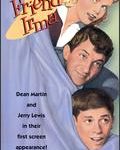 A bit of fun trivia has come to light with the recent death of Jerry Lewis. Did you know that Anaheim High has a connection to this comedy great through Class of 1933 graduate Marie Wilson?
Katherine Elizabeth “Maybelle” Wilson – a.k.a. Marie Wilson –grew up in Anaheim. An inheritance helped her fullfill her dream of becoming a Hollywood starlit. Maybelle dropped her family nickname and transformed herself into radio, TV and film star Marie Wilson, a voluptuous blonde bombshell who earned three stars on the Hollywood Walk of Fame.
Marie earned national recognition for her role in “My Friend Irma,” the title role of a radio series that became one of the most popular shows of the late 1940s. The radio show evolved into a TV series from 1952 to 1954, which then led to two movies titled, “My Friend Irma” and “My Friend Irma Goes West” featuring the comedy team of Dean Martin and Jerry Lewis.
More about this famous Anaheim High graduate is available via this link.
Ron Davini – Class of 1965
August 8, 2017 by
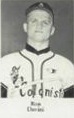 Ron Davini – AHS Class of 1965
While he was an all-around athlete, playing football, basketball, track and field and baseball, it was his outstanding performance as a catcher for the Colonists that led to Ron Davini’s life-long career in the world of baseball as a player, coach and a member of numerous professional organizations supporting America’s favorite pastime. [Read more…]
A History of Anaheim Principals
July 24, 2017 by
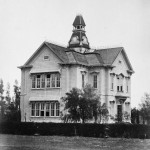
The first regular high school classes were held on the second floor of Central School beginning in 1898.
The appointment of Anaheim High’s first alumnus principal has inspired the Alumni Association to take a closer look at the men and women who have filled this top position going back to 1869.
Robert Saldivar, a Class of ’96 graduate, is Anaheim High’s newest principal and its first alumnus to fill that position.
He follows in the footsteps of 23 other men and woman who have led the high school, starting with James Miller Guinn in 1869.
The featured photo is of Joseph A. Clayes at his desk. He is Anaheim High’s longest serving principal, the creator of the Colonist logo, was instrumental in establishing the City of Anaheim Parks and Recreation program. His son and two grandsons all graduated from Anaheim high.
Click here to see a complete list of Anaheim principals and view available photos and bios.
Click below to see a gallery of available photos:
Sources: AHSAA Archives, Anaheim Library Heritage Center, “One To Twenty-Eight – A History of the Anaheim Union High School District” by Louise Booth, Natural History Museum Foundation, Los Angeles County, WorldCat record id: 23250333, and the description of Papers of James Miller Guinn, 1824-1918 (bulk 1870-1918),Huntington Library, Art Collections & Botanical Gardens, WorldCat record id: 299167713.
C. P. Evans – Anaheim Principal – 1898-1900
July 24, 2017 by
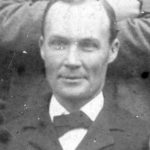
1898-1900 – C.P. Evans
C.P. Evans, who for 33 years was a teacher in the public schools in different parts of California, was the person who convinced the Anaheim school board to begin classes for 9-12 graders on the second floor of Central School in 1898, the year considered the offical start of a high school in Anaheim.
Evans was born in Cleburne County, now Calhoun County, Alabama, June 30, 1857. His father, W. H. Evans, was a Methodist minister who, in the fall of 1871, brought his family to California and settled in Farmington, San Joaquin County. He later became connected with the public schools of the district as a teacher and afterward followed the same occupation in Modesto, Stanislaus County, where he died in 1875.
C.P. Evans was still a child when his father located in Modesto, and he received his education in the public schools of the district. In March, 1876, he received his teacher’s certificate and taught school near La Grange for four years. In order to gain the advantages of special training and equipment he entered the State Normal School at San Jose and was graduated in 1883. His previous work had been so successful that it was with no difficulty that he obtained schools and he taught in Santa Barbara County for a number of years.
Eventually he went to Orange County and spent two years farming land near Anaheim. He then became principal of Loara Elementary School.
At this point in time, high school classes were not being taught in Anaheim after the departure of Anaheim’s first school principal James M. Guinn, who became the superintendent of Los Angeles schools in 1881.
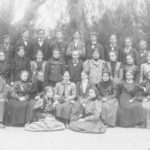
Class of 1899
In 1898, Evans convinces the school board that classes should extend past the ninth year and high school classes officially begin on the second floor of Central School. Evans becomes principal and, assisted by Miss Helen French, they teach a student body of 39 student, 17 boys and 22 girls in grades nine through twelve. He serves as principal from 1898 to 1900.
He next accepted the position of principal of the National City High School and, afterward, taught four years in the Julian high school. In 1908, he returned from Julian to National City and bought 10 1/2 acres near town and planted lemon trees. His ranch was considered one of the finest and most attractive properties in the section, situated on an elevation just outside of the city and commanding a fine view of the surrounding country.
Evans made substantial improvements to the property and installed every modern appliance to facilitate his labors, constantly implementing new and progressive methods, helping increasing his crop output each year, helping him net $10 an acre annually.
Evans married, in 1878, Miss Alice M. Fincher, a native of Missouri, and they had one daughter, Alva P.
He was a member in the Masonic order, being connected with South West Lodge, No. 283, A. F. & A. M., of National City, and was master of the lodge, while he is also well known in the affairs of the Woodmen of the World.
During the long period of his identification with school teaching his ability and force of character made him an important factor in educational expansion in the state and, although he has abandoned direct connection with school interests, he has nevertheless begun a work which is being carried forward to completion along modern lines of progress.
Adapted from “A History of San Diego County” – S.J. Clarke Publishing Co. 1913