By Dennis Bateman (AHS Class of ’89)
For many Anaheim High School students, learning a foreign language was and is a rite of passage, and during the Colony’s postwar glory era, Gene Henderson was one of the most memorable teachers on campus.
Beginning first at Fremont Junior High School and then at AHS, Henderson taught French and Spanish to young Colonists for nearly 30 years. Sadly, but perhaps unavoidably, Henderson’s life and career have been overshadowed by the sudden and violent nature of his death, which occurred 50 years ago this month. But a recent discovery revealed a hidden chapter to the life and personal history of one of Anaheim High’s finest educators. As this month is also the 106th anniversary of his birth, it is that life and legacy of Gene Henderson which deserves to be celebrated.
Eugene Kinsel Henderson was born December 28, 1919, in the town of Conneaut, Ohio, located in the northeast corner of the state off the southern shores of Lake Erie and on the border with Pennsylvania. The son of William and Sylvia Henderson, Gene attended local schools and in 1937 graduated from Conneaut High School.
It was as a student that he began his lifelong affinity for the French language. Classmates noted French as his favorite hobby, that he could often be found telling jokes, and made the bold recommendation that he should be a professor or work for National Geographic. A member of the French and Latin clubs on campus, as a senior he participated in a French play and an operetta and was a member of the school’s honor society.
From there, he moved to Athens to attend Ohio University for the next five years. He made his way through college while also working for the Nickel Plate Railroad during summers before he graduated with a bachelor’s degree in 1942.
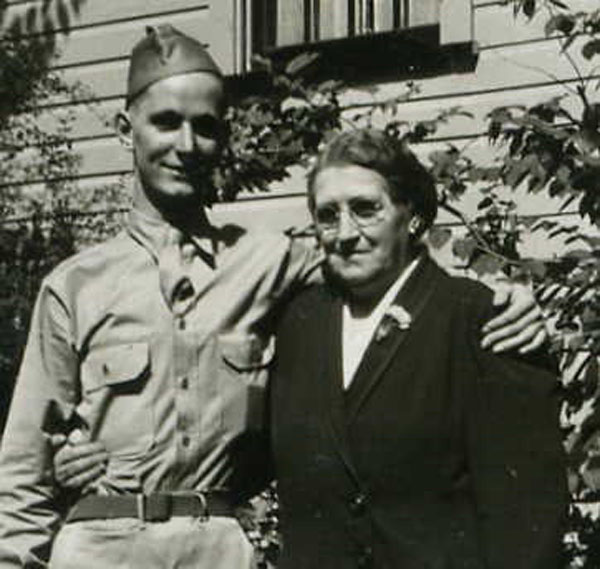
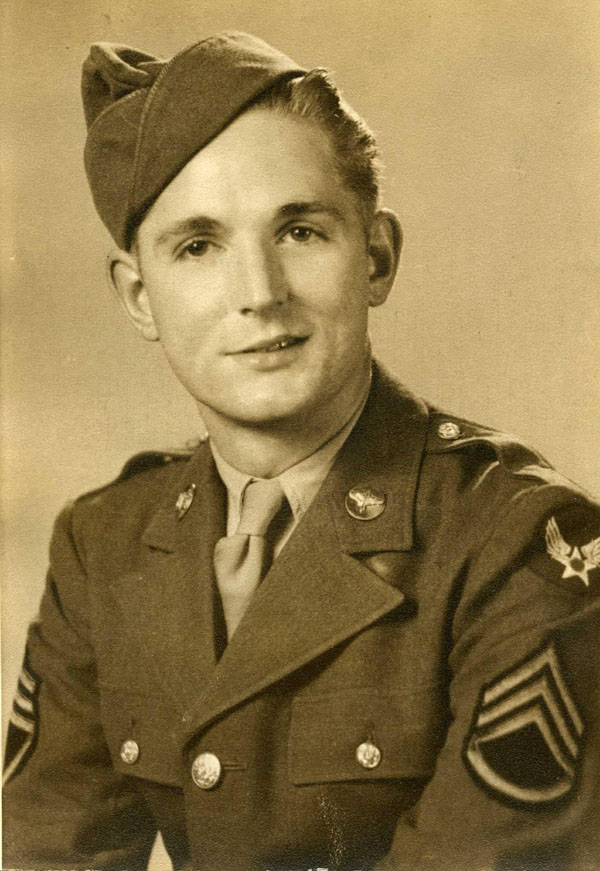 Of course, it was during this time that the United States was now fully engaged in World War II. Like many of his “Greatest Generation,” Gene Henderson answered the call of duty and enlisted in the U.S. Army Air Forces.
After completing basic and technical training, Henderson found himself sent to England to join the Allied war effort. According to the U.S. Army Air Forces Historical Society, Henderson rose to the rank of Staff Sergeant and was confirmed to have served in the 9th Air Force with the 354th Pioneer Mustang Fighter Group. This unit had the distinction of being the first to fly the famed North American P-51B Mustang in combat, providing “crucial long-range escort for bombers over Europe” and later supported ground forces after D-Day.
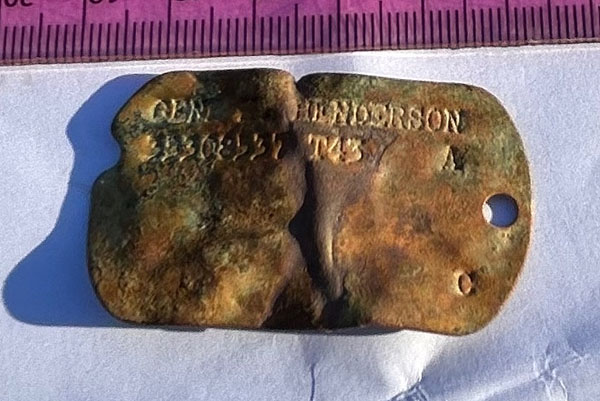 The historical society also confirmed that Staff Sergeant Henderson was ground personnel in the unit and most likely served as a trainer or mechanic. Prior to the Invasion of Europe, the 354th Fighter Group conducted training operations for its four fighter squadrons at RAF Lashenden located in Kent, a county in the southeastern corner of England. It was during this period, sometime between 1943 and 1944, that Staff Sergeant Henderson lost his military dog tags somewhere on or around the base. (More about how the dog tags were found and recovered are included later in this article.)
Following D-Day, the 354th Fighter Group moved en masse to France, jumping from various airfields in the liberated country while supporting the Allied Forces’ eastward advance. The unit was twice decorated with Distinguished Unit Citations after destroying large numbers of enemy aircraft both on the ground and in the air during the Allied thrust into Holland in September 1944 and later participated in the Battle of the Bulge in December of that year. By early 1945, as the Allies pushed into Nazi Germany, Henderson and the 354th followed and set up operations at various captured Luftwaffe airfields in occupied Mainz and Bavaria.
In the year following the end of World War II, the 354th Fighter Group returned to the United States and was later demobilized and inactivated. Henderson then left the Army Air Forces and returned to Ohio and Ohio University where he served as a Romance Language Instructor.
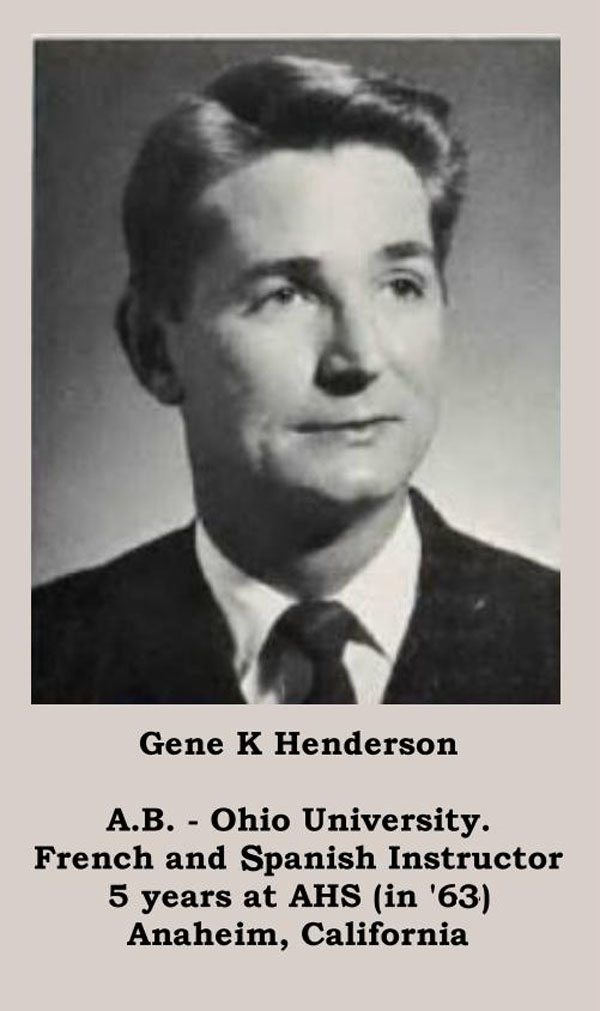 In 1954, Gene Henderson moved out to Anaheim, California where he was first hired as a French and Spanish teacher at Fremont Junior High School. After four years at Fremont, Henderson was brought to Anaheim High School to bolster the faculty there and its ability to handle the rapidly expanding student body in that era.
“I had regular conversations with him in the faculty lounge,” said Dr. Jack Clement (AHS Class of ’59), a senior when Henderson first arrived at Anaheim High School who later became a psychology/sociology teacher and was president of the AHS Teachers Association. “I always found him to be a delight to be around. He was very bright and extremely witty. He also had a great sense of humor.”
In a few short years, Monsieur Henderson was the primary French teacher on campus and was the French Club’s adviser. Together with language department chair James Edwards (Spanish) and fellow teacher Paul Peterson (German), Henderson was a vital part of an accomplished foreign language program at AHS.
“I still picture him sitting on the corner of his desk while he spoke to us in French,” said Geri Gollenger McGuff (AHS Class of ’64), who regarded Henderson as a great teacher. “He didn’t look that old to me then.”
Henderson often traveled during summers and in the 1966 COLONIST yearbook, he described what was by then his sixth trip to Europe. Noting that he was not only fluent in Spanish and French but also had familiarity with German and Italian, Henderson described to the yearbook editor his vacations, which includes visits to Austria, Belgium, Denmark, Germany, Great Britain, the Netherlands, and Switzerland, as well as his beloved France.
When asked to compare American teenagers to their European counterparts, Henderson then observed, “I think they’re very similar in dress, adhering to certain fads, and in their choice of music.”
Described by his students as well-traveled, cultured, and erudite, Mr. Henderson shared his experiences as well as his tastes to his classes.
“Mr. Henderson was my French teacher for four years at Anaheim High School. He was much beloved by his students,” said Mark Landes, who recalled that Mr. Henderson would vividly describe his culinary adventures in France so well, for example, how a certain apple cider completely refreshed the palate during a multi-course meal. “One day I asked Mr. Henderson what his favorite book was, and he said The Razor’s Edge (by W. Somerset Maugham). That was a pivotal moment in my intellectual journey.”
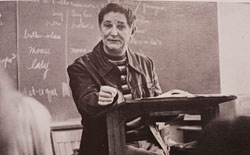 From 1966 onward, Henderson taught four levels of French and continued to advise the French Club. Outside of school, he was a member of the Benevolent & Protective Order of Elks and was active with the Anaheim Elks Lodge located at the corner of Sycamore Street and Anaheim Boulevard. A private man, Henderson lived in Anaheim and, following the death of his father in 1968, he invited his mother to live with him, which she did until she passed away in 1972.
“He used to frequent our family’s restaurant, the Old Belgium,” remembered Veronique Gerard Akers (Class of ’77), who noted that both she and her brother Patrick Gerard (Class of ’71) had learned French in Henderson’s classes. “He was such a lovely man.”
Veronique was one of Henderson’s students in December of 1975, when one morning during the final week before Christmas vacation, he failed to show up for his classes. Since Henderson had not called in sick, concern grew among fellow faculty members, and it was assistant principal Dr. Shirley Sulack who went over to his nearby apartment. What she and the Anaheim Police Department discovered was a grim sight. The apartment had been pillaged and slumped against a wall near his bed was Gene Henderson, brutally murdered just a few short weeks from what would have been his 56th birthday.
Henderson was never married and had no children and had lived his life as a ‘confirmed bachelor.’ That he was a gay man was kept in confidence by friends and colleagues. The news stunned both teachers and students alike and the tragedy cast a terrible gloom over the holiday season of 1975.
At the end of that school week, a funeral service for Henderson was held at Hilgenfeld Mortuary, officiated by Rev. Canon Kimball Saville, rector of St. Michael’s Episcopal Church. As students and fellow teachers looked on, AHS principal Avon Carlson eulogized Henderson’s life and career, and donations to his memory were encouraged to be given to the Monterey Institute of Foreign Studies.
Soon after, Anaheim Police Department detectives would apprehend a trio of assailants, who were under the mistaken impression that Henderson was somehow wealthy and kept cash in his residence. According to newspaper reports of that time, “Henderson had befriended the trio and invited them into his apartment. He was bludgeoned to death with a torque wrench and a bottle of wine. The three killers found only a jarful of change valued at approximately $30.” Henderson’s assailants were put on trial in 1977 and pronounced guilty of first-degree murder in 1978 and all continue to serve life sentences within the California prison system.
 Sometime earlier this year, a retired Englishman named Frank Roots from Smarden in Kent was engaging in his longtime hobby of metal detecting when he came across brass dog tags in a pasture located near the Headcorn Aerodrome, a private airfield that had been known during World War II as RAF Lashenden. Though weathered after years of exposure and burial in the ground, the U.S. military-issued identification clearly indicated the name Gene K. Henderson and his military service number, which were then confirmed by official records.
A fellow Englishman named Simon Fogg posted about his friend’s finding in a popular Anaheim forum on Facebook, and soon after, connections were made with the Anaheim High School Alumni Association. As Henderson had no surviving immediate family, his dog tags were donated in trust to the AHSAA. Earlier this month, the dog tags were received and will soon be put on display at Anaheim High School to honor the life and service of a great Colonist teacher.
“Au revoir et adieu, Monsieur Henderson.”